

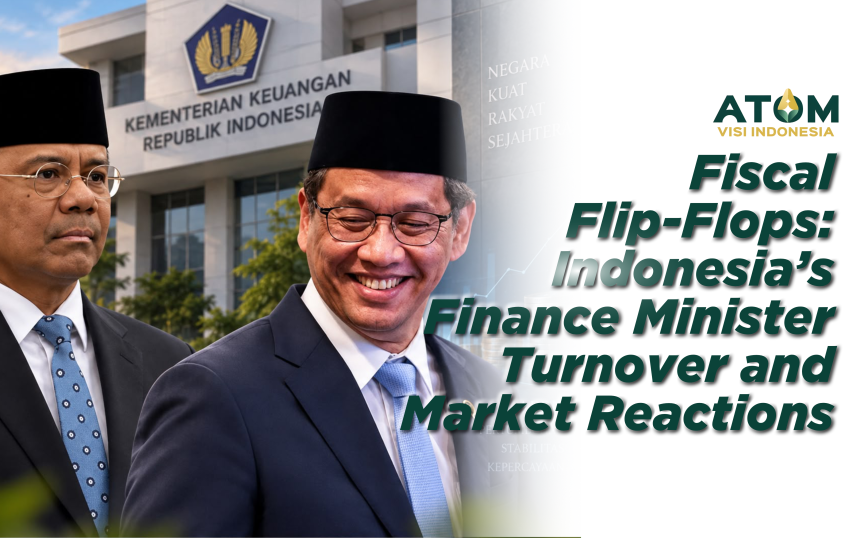
Fiscal Flip-Flops: Indonesia’s Finance Minister Turnover and Market Reactions
Indonesia’s leadership has seen an unusually rapid turnover at the top of its finance ministry. Within less than two years, President Prabowo Subianto replaced two finance ministers: in September 2025, veteran Sri Mulyani Indrawati was replaced by Purbaya Yudhi Sadewa; in September 2026, Purbaya was replaced by his deputy, Suahasil Nazara. The succession has attracted international attention not simply because of the personnel changes, but because each appointment has been interpreted as a signal about the direction of fiscal policy under Prabowo. When Sri Mulyani was removed, international investors largely interpreted the decision as a potential weakening of Indonesia’s established fiscal discipline. A year later, Purbaya’s removal was interpreted differently: the appointment of Suahasil, a long-serving technocrat familiar with the Finance Ministry, was viewed by several analysts as an attempt to restore policy predictability while maintaining the government’s broader growth ambitions. The contrast illustrates how changes at the finance ministry can become a proxy for a much larger question: whether Indonesia’s economic strategy is changing, or whether the government is simply changing the person responsible for implementing it.
The broader economic picture is more complicated than the political turnover alone suggests. Indonesia’s economy grew 5.29 percent year-on-year in the second quarter of 2026 and 5.45 percent in the first half of the year, indicating that the economy has continued expanding despite external and domestic pressures. Investment has also remained relatively resilient: BKPM recorded Rp1,010.6 trillion in investment realization during the first half of 2026, up 7.2 percent year-on-year, with foreign direct investment accounting for Rp507.6 trillion. At the same time, financial markets have been considerably more sensitive than the real economy. The rupiah has faced sustained depreciation pressures, while Indonesian equities have been affected by concerns over fiscal policy, global interest rates, commodity prices and governance. Reuters’ September 2026 reporting noted that investor sentiment toward Indonesia improved after Purbaya’s replacement, but also stressed that broader factors, including higher US Treasury yields and rising oil prices, continued to influence emerging-market currencies. This distinction matters: ministerial turnover can trigger an immediate market reaction, but it cannot by itself explain movements in the rupiah, IHSG, investment or economic growth.
The difference in international reaction becomes clearest when comparing September 2025 with September 2026. Sri Mulyani’s dismissal generated an unusually strong negative response because investors had attached considerable institutional credibility to her tenure. Reuters reported that the rupiah fell by more than 1 percent following the announcement, while Jakarta stocks also declined and Bank Indonesia intervened to stabilize financial markets. Bloomberg similarly reported that global funds viewed her as a figure associated with fiscal responsibility and that the stock market, currency and government bonds weakened following her removal. Foreign investors subsequently sold a net US$276.5 million of Indonesian equities on September 9, while demand at a government bond auction was also weaker. The reaction therefore reflected more than uncertainty about a new minister: it reflected uncertainty about whether the policy framework associated with Sri Mulyani would survive her departure.
Purbaya’s arrival initially represented a different economic signal. His early policy moves emphasized accelerating growth and injecting liquidity into the banking system, including a plan to place substantial government funds in state-owned banks. Bloomberg reported that he moved quickly to review the previous administration’s fiscal assumptions and consider changes to the 2026 budget, signalling a stronger orientation toward the government’s growth agenda. This did not necessarily translate into uniformly negative market perceptions. In fact, parts of the domestic market initially welcomed the prospect of stronger liquidity and economic stimulus. However, international commentary increasingly focused on the tension between faster growth, fiscal expansion and policy predictability. By the end of his tenure, concerns had broadened to include fiscal pressures, relations between fiscal and monetary authorities, and questions about the consistency of policymaking. The Financial Times subsequently described Purbaya’s advocacy of looser fiscal policy and his disagreements with the central bank as sources of market unease, while CNA reported that analysts also pointed to internal restructuring within the Finance Ministry and disagreements surrounding Danantara as possible factors behind his removal. These explanations remain analyst interpretations rather than officially confirmed reasons for the dismissal.
The international response to Suahasil’s appointment has consequently been more measured. Reuters described the change as a move that could ease investor jitters, while the Financial Times noted that markets initially reacted negatively to Purbaya’s dismissal before recovering after Suahasil was named. The Straits Times placed particular emphasis on Suahasil’s experience inside the Finance Ministry and the possibility of improving coordination between fiscal and monetary authorities. CNA likewise interpreted his appointment as a signal that Prabowo may want to pursue ambitious growth targets through a more cautious and fiscally disciplined approach. Meanwhile, the Australian and other regional coverage has highlighted a more skeptical question: whether a change in minister can actually resolve the underlying fiscal pressures if the government’s spending ambitions remain unchanged. This divergence is important because it shows that international observers are not uniformly celebrating the turnover; rather, they are watching whether Suahasil’s appointment produces measurable changes in fiscal credibility and policy communication.
The contrast is also visible in the response of foreign business communities. Marc Mealy of the US-ASEAN Business Council argued that changes in ministerial personnel do not necessarily alter American investment interest in Indonesia when they are not accompanied by major policy changes. This is consistent with Indonesia’s investment data: despite the political changes, first-half 2026 investment realization increased 7.2 percent year-on-year. The evidence therefore does not support a simple conclusion that ministerial turnover automatically drives foreign investors away. Instead, markets appear to distinguish between a temporary personnel shock and a sustained change in policy conditions.
Ultimately, the two ministerial changes produced different international readings because they represented different moments in Indonesia’s economic trajectory. Sri Mulyani’s removal generated concern over the possible erosion of an established fiscal anchor; Purbaya’s tenure was associated with a more interventionist growth strategy that attracted both support and questions over fiscal and institutional predictability; and Suahasil’s appointment has been interpreted as an effort to restore confidence without necessarily abandoning Prabowo’s growth agenda. The key test, therefore, is not whether markets initially rise or fall when a minister is appointed. It is whether the new minister can translate the credibility associated with his appointment into a consistent budget framework, disciplined deficit management, predictable communication and effective coordination with Bank Indonesia. The fact that Indonesia continues to record roughly 5 percent economic growth and rising investment while its currency and financial markets remain under pressure illustrates the central paradox: the country’s economic fundamentals have not simply collapsed, but investors are increasingly sensitive to how fiscal policy is designed, communicated and implemented.
References
Antara News. (2026, September 16). AS: Pergantian Menkeu tidak pengaruhi minat investasi AS di Indonesia. https://www.antaranews.com/berita/5744188/as-pergantian-menkeu-tidak-pengaruhi-minat-investasi-as-di-indonesia
Badan Pusat Statistik. (2026, August 5). Ekonomi Indonesia triwulan II-2026 tumbuh 5,29 persen (y-on-y). https://www.bps.go.id/id/pressrelease/2026/08/05/2605/ekonomi-indonesia-triwulan-ii-2026-tumbuh-5-29-persen–y-on-y-.html
Bloomberg. (2025, September 8). Indonesia: Prabowo’s removal of finance minister Indrawati set to rattle markets. https://www.bloomberg.com/news/articles/2025-09-08/indonesia-prabowo-s-removal-of-finance-minister-indrawati-set-to-rattle-markets
Bloomberg. (2025, September 10). Indonesia bonds, stocks take hit after removal of finance minister Indrawati. https://www.bloomberg.com/news/articles/2025-09-10/indonesian-bond-demand-stocks-hit-after-finance-minister-exit
Bloomberg. (2025, September 11). Indonesia’s new finance chief moves fast with $12 billion economic boost. https://www.bloomberg.com/news/articles/2025-09-11/indonesia-s-new-finance-chief-moves-fast-with-12-billion-economic-boost
Channel NewsAsia. (2026, September 16). What led to Purbaya’s sacking as Indonesia’s finance minister—and the challenges facing successor Suahasil. https://www.channelnewsasia.com/asia/purbaya-suahasil-reshuffle-indonesia-finance-ministry-6385141
Financial Times. (2026, September). Indonesia’s Prabowo Subianto fires finance minister after just a year. https://www.ft.com/content/5114d032-164b-4a7b-b71a-0b1f4c994af6
Indrajaya, R. (2025, September 9). Di balik pergantian Menkeu, saat poros dunia bergeser dari IMF ke BRICS dan Soemitronomic. Pikiran Rakyat. https://www.pikiran-rakyat.com/kolom/pr-019634538/di-balik-pergantian-menkeu-saat-poros-dunia-bergeser-dari-imf-ke-brics-dan-soemitronomic
Kementerian Investasi dan Hilirisasi/BKPM. (2026, July 17). Realisasi investasi semester I 2026 tembus Rp1.010 triliun, serap 1,4 juta tenaga kerja langsung. https://bkpm.go.id/id/info/siaran-pers/realisasi-investasi-semester-i-2026-tembus-rp-1-010-t-serap-1-4-juta-tenaga-kerja-langsung
Kompas.com. (2026, September 15). Media asing ramai soroti penggantian Menkeu RI dari Purbaya ke Suahasil, apa kata mereka? https://www.kompas.com/tren/read/2026/09/15/080000565/media-asing-ramai-soroti-penggantian-menkeu-ri-dari-purbaya-ke-suahasil-apa?page=all
Reuters. (2025, September 9). Indonesian finance minister’s removal unnerves investors, rupiah tumbles. https://www.reuters.com/world/asia-pacific/indonesian-finance-ministers-removal-unnerves-investors-rupiah-tumbles-2025-09-09/
Reuters. (2026, September 14). ‘Good move’: Indonesia’s finance minister switch will ease investor jitters. https://www.reuters.com/world/asia-pacific/good-move-indonesias-finance-minister-switch-will-ease-investor-jitters-2026-09-14/
Reuters. (2026, September 17). Dollar’s allure, oil surge fan bearish bets on emerging Asian currencies. https://www.reuters.com/world/asia-pacific/dollars-allure-oil-surge-fan-bearish-bets-emerging-asian-currencies-2026-09-17/
Suroyo, G., Sulaiman, S., & Banerjee, A. (2026, September 14). ‘Good move’: Indonesia’s finance minister switch will ease investor jitters. Reuters. https://www.reuters.com/world/asia-pacific/good-move-indonesias-finance-minister-switch-will-ease-investor-jitters-2026-09-14/
The Straits Times. (2026, September 14). Prabowo replaces Finance Minister Purbaya in long-awaited Indonesian Cabinet shake-up. https://www.straitstimes.com/asia/se-asia/prabowo-replaces-finance-minister-purbaya-in-long-awaited-indonesian-cabinet-shake-up
Ayudiana, S. (2026, September 16). AS: Pergantian Menkeu tidak pengaruhi minat investasi AS di Indonesia. Antara News. https://www.antaranews.com/berita/5744188/as-pergantian-menkeu-tidak-pengaruhi-minat-investasi-as-di-indonesia